2026 Nobel Prize in Chemistry Announced
2026年诺贝尔化学奖揭晓
Èr líng èr liù nián Nuòbèi'ěr huàxué jiǎng jiēxiǎo
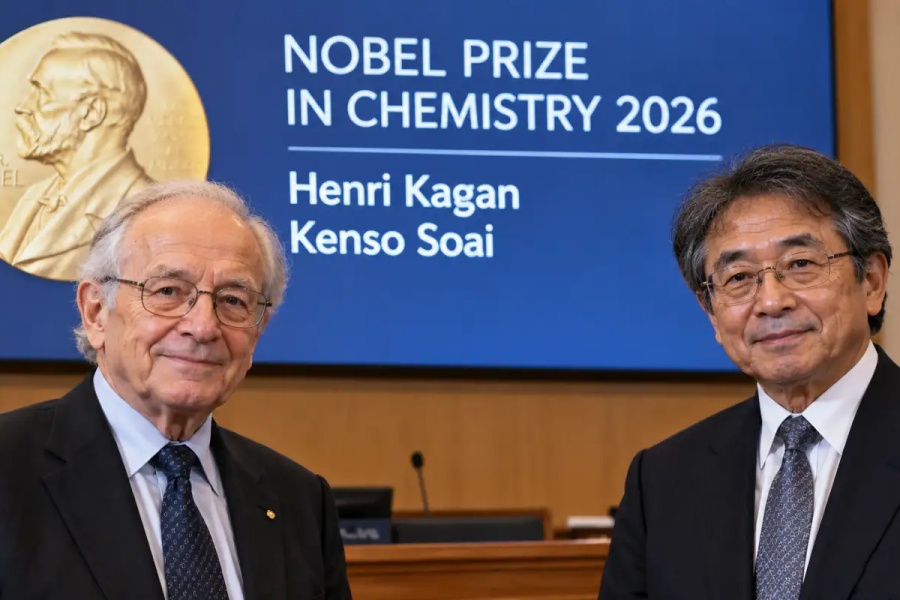
On October 7, 2026, the Royal Swedish Academy of Sciences announced that the Nobel Prize in Chemistry would be awarded to two scientists: Henri B. Kagan from France and Kenso Soai from Japan. They won the prize for discovering non-linear effects and autocatalysis in asymmetric organic synthesis — research that helps explain why some molecules exist in "left-handed" and "right-handed" forms. The two scientists will share a prize of 12 million Swedish kronor.
翻译 Translation
当地时间10月7日,瑞典皇家科学院宣布,将2026年诺贝尔化学奖授予两名科学家。他们分别是法国科学家亨利·B·卡甘和日本科学家硖合宪三。获奖原因是他们发现了不对称有机合成中的非线性效应和自催化现象。
On October 7 local time, the Royal Swedish Academy of Sciences announced that the 2026 Nobel Prize in Chemistry would be awarded to two scientists. They are French scientist Henri B. Kagan and Japanese scientist Kenso Soai. The reason for the award is their discovery of non-linear effects and autocatalysis in asymmetric organic synthesis.
卡甘来自法国巴黎南大学,硖合宪三来自日本东京理科大学。两人的研究解决了一个存在了一百多年的科学难题:为什么有些分子会像人的左手和右手一样,形成两种互为镜像但无法重合的结构?
Kagan is from the University of Paris-Sud in France, and Soai is from the Tokyo University of Science in Japan. Their research solved a scientific puzzle that had existed for over a hundred years: why do some molecules, like a person's left and right hands, form two structures that are mirror images of each other but cannot be superimposed?
诺贝尔
Nobel
proper noun
诺贝尔奖是世界上最有名的奖项之一。
The Nobel Prize is one of the most famous awards in the world.
化学
chemistry
noun
他在大学里学的是化学专业。
He studied chemistry at university.
揭晓
to announce; to reveal
verb
比赛结果将在明天揭晓。
The competition results will be announced tomorrow.
瑞典
Sweden
proper noun
瑞典是北欧的一个国家。
Sweden is a country in Northern Europe.
皇家
royal
adjective
这座皇家花园非常漂亮。
This royal garden is very beautiful.
科学院
academy of sciences
noun
他在科学院工作了很多年。
He worked at the academy of sciences for many years.
授予
to award; to confer
verb
学校授予他优秀学生的称号。
The school awarded him the title of outstanding student.
科学家
scientist
noun
这位科学家获得了国际大奖。
This scientist won an international award.
分别
respectively
adverb
他们分别来自中国和日本。
They come from China and Japan respectively.
不对称
asymmetric
adjective
这个图案左右不对称。
This pattern is not symmetrical left and right.
有机
organic
adjective
有机食品越来越受欢迎。
Organic food is becoming more and more popular.
合成
to synthesize; synthesis
verb/noun
这种材料是人工合成的。
This material is artificially synthesized.
非线性
non-linear
adjective
非线性方程比线性方程复杂得多。
Non-linear equations are much more complex than linear ones.
效应
effect
noun
这种药物有明显的副效应。
This drug has obvious side effects.
自催化
autocatalysis
noun
自催化是一种特殊的化学反应。
Autocatalysis is a special kind of chemical reaction.
难题
difficult problem
noun
这道数学难题我做了很久。
I spent a long time on this difficult maths problem.
分子
molecule
noun
水分子由氢和氧组成。
Water molecules are made of hydrogen and oxygen.
镜像
mirror image
noun
这两个图形互为镜像。
These two figures are mirror images of each other.
重合
to overlap; to coincide
verb
这两个三角形完全重合。
These two triangles completely overlap.
结构
structure
noun
这篇文章的结构很清晰。
The structure of this article is very clear.
手性
chirality
noun
手性是化学中的一个重要概念。
Chirality is an important concept in chemistry.
药物
drug; medicine
noun
这种药物对治疗感冒很有效。
This drug is very effective for treating colds.
有害
harmful
adjective
吸烟对身体有害。
Smoking is harmful to health.
控制
to control; control
verb/noun
他控制住了自己的情绪。
He controlled his emotions.
反应
reaction; to react
noun/verb
化学反应的速率受温度影响。
The rate of chemical reactions is affected by temperature.
生成
to generate; to produce
verb
燃烧会生成二氧化碳。
Burning generates carbon dioxide.
研发
research and development
verb/noun
这家公司投入大量资金研发新产品。
This company invests a lot of money in R&D for new products.
材料
material
noun
这种材料很轻,但是很结实。
This material is very light but very strong.
平分
to divide equally; to share
verb
他们平分了这笔奖金。
They divided the prize money equally.
奖金
prize money; bonus
noun
他拿到了一笔丰厚的奖金。
He received a generous bonus.
克朗
krona (Swedish currency)
noun
这件衣服花了五百克朗。
This piece of clothing cost five hundred kronor.
领域
field; domain
noun
他在医学领域工作了三十年。
He has worked in the medical field for thirty years.
奖项
award; prize
noun
这个奖项每年颁发一次。
This award is given out once a year.
荣誉
honour
noun
获得这个荣誉是他一生中最大的骄傲。
Receiving this honour is the greatest pride of his life.
推动
to promote; to push forward
verb
科技推动社会进步。
Technology promotes social progress.
理论
theory
noun
这个理论需要更多实验来证明。
This theory needs more experiments to prove it.
贡献
contribution; to contribute
noun/verb
他为科学事业做出了巨大贡献。
He made great contributions to the cause of science.
设计
to design; design
verb/noun
这个房间的设计很现代。
The design of this room is very modern.
有效
effective
adjective
这种学习方法很有效。
This learning method is very effective.
委员会
committee
noun
委员会决定了下一次会议的时间。
The committee decided the time of the next meeting.
里程碑
milestone
noun
这项发现是医学史上的里程碑。
This discovery is a milestone in the history of medicine.
当地
local
noun/adjective
当地人对我们非常热情。
The local people were very warm to us.
时间
time
noun
我们时间不多了,要快一点。
We do not have much time left; we need to hurry.
未来
future
noun
我们要为未来做好准备。
We need to prepare for the future.
分别 (fēnbié)
"分别" means "respectively" or "separately." It is used when two or more people or things are mentioned together, and you want to indicate which one corresponds to which. The structure is "A 和 B 分别 + verb." It helps clarify the relationship between multiple subjects and their actions.
我和弟弟分别住在北京和上海。
My younger brother and I live in Beijing and Shanghai respectively.
这两本书分别是我和姐姐的。
These two books belong to me and my older sister respectively.
老师给小明和小红分别布置了不同的作业。
The teacher assigned different homework to Xiao Ming and Xiao Hong respectively.
从而 (cóng'ér)
"从而" means "thus," "thereby," or "as a result." It is used to introduce a result or consequence that follows from a previous action or situation. It is more formal than "所以" and is very common in news reports, academic writing, and analytical texts.
他每天坚持锻炼身体,从而保持了良好的健康状态。
He persisted in exercising every day, thereby maintaining good health.
这家公司改进了生产技术,从而大大降低了成本。
This company improved its production technology, thereby greatly reducing costs.
她每天听中文广播,从而提高了听力水平。
She listens to Chinese radio every day, thereby improving her listening skills.
不仅……也…… (bùjǐn... yě...)
"不仅……也……" means "not only... but also..." It is used to add more information and emphasise that there is an additional point. The structure is "不仅 + A + 也 + B." It is very common in both spoken and written Chinese and can connect nouns, verbs, adjectives, or clauses.
这次旅行不仅让我放松了心情,也让我认识了很多新朋友。
This trip not only helped me relax but also let me meet many new friends.
他不仅会说中文,也会说日语和法语。
He can not only speak Chinese but also Japanese and French.
这家餐厅不仅环境好,服务也很周到。
This restaurant not only has a good environment but also very attentive service.
Tag:Tech & Science

You may also like

Tesla’s Third-Quarter Profit Falls 29%
October 29, 2026

China’s Baidu Tests Robotaxi on London Streets
October 28, 2026

Subscribe
Login
0 Comments
Oldest