
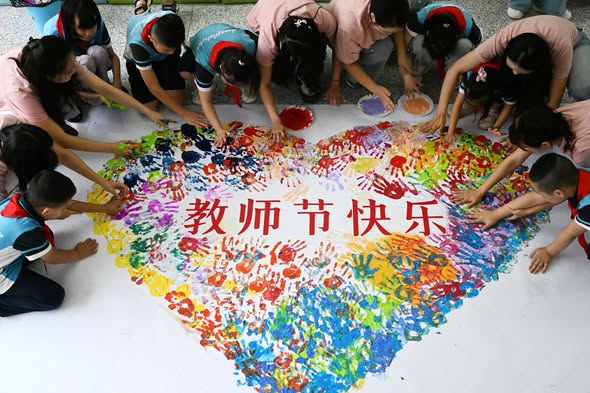
Nationwide Celebrations Held Across China on Teachers’ Day
教师节当天全国各地举办庆祝活动
Jiàoshī Jié dāngtiān quánguó gèdì jǔbàn qìngzhù huódòng
September 10, 2026 was China's 42nd Teachers' Day. In many cities, tall buildings lit up with messages like "Hello, teacher!" At schools, students gave teachers flowers, sang songs, and bowed to say thank you. Shops and train companies also offered special discounts for teachers.
翻译 Translation
2026年9月10日是中国的第42个教师节。这一天,全国很多地方都在庆祝。今年的主题是“大力弘扬教育家精神,共筑尊师重教风尚”。大家用不同的方式感谢老师。
September 10, 2026 was China's 42nd Teachers' Day. On this day, many places across the country celebrated. This year's theme was "Vigorously promote the educator's spirit, and jointly build a trend of respecting teachers and valuing education." Everyone used different ways to thank teachers.
教师
teacher
noun
我的爸爸是一名中学教师。
My dad is a middle school teacher.
庆祝
to celebrate
verb
我们一家人一起庆祝奶奶的生日。
Our whole family celebrated Grandma's birthday together.
主题
theme; topic
noun
这次班会的主题是“我的梦想”。
The theme of this class meeting is "My Dream."
弘扬
to promote; to carry forward
verb
我们要弘扬中国传统文化。
We should carry forward traditional Chinese culture.
精神
spirit; morale
noun
他的学习精神值得我们学习。
His learning spirit is worth learning from.
尊师重教
to respect teachers and value education
idiom
尊师重教是中国的传统美德。
Respecting teachers and valuing education is a traditional Chinese virtue.
风尚
trend; prevailing custom
noun
节约用水是一种好的社会风尚。
Saving water is a good social trend.
方式
way; method
noun
我喜欢用听音乐的方式放松。
I like to relax by listening to music.
感谢
to thank; to be grateful
verb
我要感谢我的朋友们对我的帮助。
I want to thank my friends for their help.
高楼
tall building; high-rise
noun
这个城市有很多高楼。
This city has many tall buildings.
亮
to light up; bright
verb/adjective
天亮了,该起床了。
It's daylight; time to get up.
温暖
warm
adjective
春天的阳光很温暖。
The spring sunshine is very warm.
祝福
blessing; to bless
noun/verb
祝你生日快乐,这是我给你的祝福。
Happy birthday to you; this is my blessing for you.
屏幕
screen
noun
电视屏幕很大。
The TV screen is very big.
播放
to play; to broadcast
verb
收音机正在播放一首老歌。
The radio is playing an old song.
到处
everywhere
adverb
公园里到处是花。
There are flowers everywhere in the park.
灯光
light; lighting
noun
舞台的灯光很漂亮。
The stage lighting is very beautiful.
各种
various; all kinds of
phrase
商店里有各种颜色的衣服。
The shop has clothes in various colors.
画
to draw; painting
verb/noun
弟弟喜欢画画。
My younger brother likes to draw.
贺卡
greeting card
noun
新年的时候,我给朋友寄了一张贺卡。
During the New Year, I sent a greeting card to my friend.
手工
handicraft; handmade
noun/adjective
这个手工礼物是我自己做的。
This handmade gift was made by myself.
礼物
gift; present
noun
她收到了很多生日礼物。
She received many birthday gifts.
感动
to be moved; touching
verb/adjective
这个故事让我很感动。
This story moved me very much.
鞠躬
to bow
verb
演员表演结束后向观众鞠躬。
After the performance, the actors bowed to the audience.
大声
loudly
adverb
他大声地读课文。
He read the text aloud.
举办
to hold; to host
verb
学校下周举办运动会。
The school will hold a sports meet next week.
校园
campus
noun
我们的校园很美丽。
Our campus is very beautiful.
热闹
lively; bustling
adjective
春节的时候街上很热闹。
The streets are very lively during Spring Festival.
商店
shop; store
noun
我去商店买水果。
I go to the shop to buy fruit.
公司
company
noun
他在一家电脑公司工作。
He works at a computer company.
优惠
discount; preferential
noun/adjective
这家店对学生有优惠。
This shop offers discounts to students.
化妆品
cosmetics
noun
妈妈在商店买化妆品。
Mom buys cosmetics at the shop.
便宜
cheap; inexpensive
adjective
这个书包很便宜。
This backpack is very cheap.
火车
train
noun
我们坐火车去上海。
We take the train to Shanghai.
积分
points; credits
noun
我在超市买东西得到了很多积分。
I got many points from buying things at the supermarket.
表达
to express
verb
我想表达我对你的感谢。
I want to express my thanks to you.
尊敬
to respect; respect
verb/noun
我们应该尊敬老人。
We should respect the elderly.
除了
besides; except
preposition
除了苹果,我还买了香蕉。
Besides apples, I also bought bananas.
方法
method; way
noun
这个方法很好,我们可以试一试。
This method is good; we can try it.
辛苦
hard-working; tiring
adjective
妈妈每天工作很辛苦。
Mom works very hard every day.
用……的方式 (yòng... de fāngshì)
Structure: 用 + [method] + 的方式 + [verb phrase]
This pattern means "in the way of..." or "by means of..." It is used to describe how someone does something. It is very common when talking about different approaches or methods.
You can use it to explain how people do things in different ways.
大家用不同的方式感谢老师。
Everyone thanked their teachers in different ways.
我用打电话的方式和妈妈聊天。
I chat with my mom by making phone calls.
老师用做游戏的方式教我们学中文。
The teacher teaches us Chinese by playing games.
除了……,也/还…… (chúle... yě/hái...)
Structure: 除了 + A + 也/还 + B
This pattern means "besides... also..." It is used to add more information. It shows that B is in addition to A.
This is a very useful pattern when you want to mention more than one thing.
除了学生,很多商店和公司也想感谢老师。
Besides students, many shops and companies also wanted to thank teachers.
除了中文,我还会说英语。
Besides Chinese, I can also speak English.
除了跑步,他也喜欢游泳。
Besides running, he also likes swimming.
有的……,有的……,还有的…… (yǒude... yǒude... hái yǒude...)
Structure: 有的 + A,有的 + B,还有的 + C
This pattern means "some..., some..., and some..." It is used when talking about different groups or types within a larger group. You can use two, three, or even more "有的" to list different categories.
It is very common when describing variety or differences among people or things. The more "有的" you use, the more detailed your description becomes.
有的同学画了画,有的做了贺卡,还有的做了手工花。
Some students drew pictures, some made cards, and some made handmade flowers.
公园里,有的人在跑步,有的人在跳舞,还有的人在唱歌。
In the park, some people are running, some are dancing, and some are singing.
我的同学有的来自北京,有的来自上海,还有的来自广州。
Some of my classmates come from Beijing, some from Shanghai, and some from Guangzhou.
向…… (xiàng...)
Structure: 向 + [person] + [verb phrase]
"向" is a preposition that means "toward," "to," or "from." When used with a person, it shows the direction of an action, often in the sense of expressing something to someone or doing something facing someone.
It is very common in formal and polite contexts, such as bowing to someone, expressing thanks to someone, or asking someone a question.
全班同学一起站起来,向老师鞠躬。
The whole class stood up together and bowed to the teacher.
我要向你说一声谢谢。
I want to say thank you to you.
他向我问了一个问题。
He asked me a question.
越来越……了 (yuè lái yuè... le)
Structure: 越来越 + [adjective / verb phrase] + 了
This pattern means "more and more..." or "increasingly..." The "了" at the end shows that the change has already started or is continuing. It is placed before an adjective or a verb phrase.
This is a very common pattern in everyday Chinese and can be used to describe changes in weather, feelings, skills, or anything that develops over time.
天气越来越热了。
The weather is getting hotter and hotter.
他的中文越来越好了。
His Chinese is getting better and better.
街上的人越来越多了。
There are more and more people on the street.

You may also like
Specialty Mooncakes Hit the Market as Mid-Autumn Festival Approaches
September 23, 2026

Top Mid-Autumn Moon Watching Spots
September 21, 2026
24-Hour Automated Public Libraries in Chinese Cities
September 16, 2026
Subscribe
Login
0 Comments
Oldest