Lesson 3:金箍棒 The Golden Staff
Sun Wukong has returned to his mountain — but something is missing. He has defeated demons, claimed his throne, and won the loyalty of his monkey troop. Yet without a weapon worthy of his power, he feels incomplete. A wise old monkey suggests a visit to the Dragon King of the Eastern Sea. What follows is a chase through the depths of the ocean, a legendary iron pillar that answers to his call, and a treasure unlike any other. This is the story of how the Monkey King found his match — not in a rival, but in a staff that bends to his will.
孙悟空打败了混世魔王之后,心里想:“我们猴子虽然多,但是没有一件像样的兵器。万一再有妖怪来侵犯,怎么保护大家呢?”
于是,他施展法术,来到傲来国的兵器库,搬走了里面的所有兵器。回到花果山,他让群猴每人挑选一件兵器,每天操练武艺。
消息传开,花果山附近的七十二洞妖王,都被孙悟空的本领所折服,纷纷前来拜见,尊他为王。
可是,孙悟空自己却没有一件称手的兵器。他用的那把大刀太轻了。
一只老猴子建议说:“大王,听说东海龙王那里有很多宝贝兵器,大王何不去向龙王讨一件?”
孙悟空一听,立刻来到东海龙宫。东海龙王听说美猴王来了,亲自出来迎接。孙悟空说明来意,龙王不好意思拒绝,就让人抬出一件又一件兵器——一把大刀、一柄九股叉、一杆方天画戟……孙悟空试了试,都嫌太轻。
龙王说:“再也没有更重的兵器了。”这时,龙后悄悄对龙王说:“我们海里那根定海神针,最近总是在放光。也许是有缘人来了。不如让他去试试?”
龙王对孙悟空说:“我有一根神铁,重一万三千五百斤。你要是能拿得动,就送给你。”孙悟空跟着龙王来到海底。只见一根巨大的铁柱子,上面刻着一行字:“如意金箍棒”。
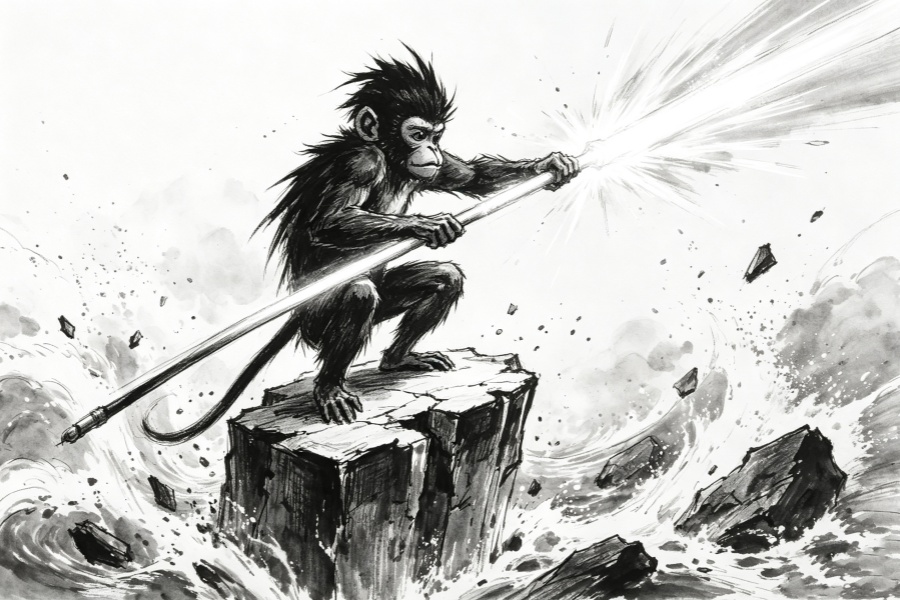
孙悟空心里默默地说:“要是能再细一点、再短一点就好了。”那根神铁竟然真的缩小了一些。孙悟空又说:“再细一点!”神铁又缩小了。最后,它变成了一根碗口粗细、两丈长短的铁棒,刚好称手。
孙悟空大喜过望,挥挥舞金箍棒,把龙宫搅得天翻地覆。龙王吓得浑身发抖,只好把金箍棒送给了他。
孙悟空带着金箍棒回到花果山,群猴欢呼雀跃。从此,美猴王有了最称手的兵器,花果山也成了谁都不敢侵犯的地方。但是,孙悟空还不知道,更大的冒险正在等着他……
兵器
weapon; armament
Noun
在古代,兵器是战争中最重要的工具。
In ancient times, weapons were the most important tools in warfare.
像样
decent; presentable; up to standard
Adjective
他工作多年,终于买了一间像样的房子。
After working for many years, he finally bought a decent house.
侵犯
to invade; to attack; to encroach upon
Verb
任何国家都不应该侵犯别国的领土。
No country should invade the territory of another country.
施展
to display; to wield (skills, powers, etc.)
Verb
他第一次在比赛中施展了自己的真正实力。
For the first time, he displayed his true abilities in the competition.
操练
to drill; to practice; to train
Verb
士兵们每天早晨都在操场上操练。
The soldiers drill on the parade ground every morning.
武艺
martial arts skills; military prowess
Noun
他的武艺非常高强,没有人能打败他。
His martial arts skills are extremely strong — no one can defeat him.
折服
to admire; to be convinced; to yield to
Verb
观众们都被这位艺术家的表演所折服。
The audience was all captivated by this artist's performance.
纷纷
one after another; in succession
Adverb
听到好消息后,大家纷纷鼓掌庆祝。
After hearing the good news, everyone applauded and celebrated one after another.
称手
handy; well-fitting (of a tool); comfortable to use
Adjective
这把刀用起来很称手,切菜快多了。
This knife is very handy to use — it cuts vegetables much faster.
建议
to suggest; to propose; a suggestion
Verb / Noun
老师建议我们每天早上朗读半小时中文。
The teacher suggests we read Chinese aloud for half an hour every morning.
宝贝
treasure; precious object; darling
Noun
这个花瓶是他最珍贵的宝贝。
This vase is his most precious treasure.
龙宫
Dragon Palace; the underwater palace of the Dragon King in Chinese mythology
Proper Noun
东海龙宫里住着东海龙王。
The Dragon King of the Eastern Sea lives in the Eastern Sea Dragon Palace.
迎接
to welcome; to greet; to meet (someone arriving)
Verb
全家人都在机场迎接他回国。
The whole family was at the airport to welcome him back to the country.
拒绝
to refuse; to reject; to decline
Verb
他礼貌地拒绝了我的邀请。
He politely declined my invitation.
定海神针
The Magic Needle That Calms the Sea; the original name of the Golden-Hooped Staff
Proper Noun
定海神针原本是龙宫用来镇海的宝贝。
The Magic Needle That Calms the Sea was originally a treasure used by the Dragon Palace to stabilize the sea.
有缘人
a person who is fated or destined (to find something)
Noun
传说这件宝贝一直在等待它的有缘人。
Legend says this treasure has been waiting for its destined person.
神铁
divine iron; magical iron
Noun
这块神铁重达一万多斤。
This piece of divine iron weighs over 10,000 jin.
如意
as one wishes; to one's satisfaction; compliant
Adjective / Verb
祝你一切如意,心想事成。
May everything go as you wish and may all your dreams come true.
金箍棒
The Golden-Hooped Staff; Sun Wukong's legendary weapon
Proper Noun
孙悟空总是把金箍棒藏在耳朵里。
Sun Wukong always hides his Golden-Hooped Staff in his ear.
竟然
unexpectedly; to one's surprise; contrary to expectations
Adverb
他竟然在那么短的时间内完成了任务。
Unexpectedly, he completed the task in such a short time.
缩小
to shrink; to reduce in size
Verb
这件衣服洗了之后缩小了很多。
This piece of clothing shrank a lot after washing.
粗细
thickness; diameter (lit. "thickness and thinness")
Noun
这根木棍的粗细刚好适合我握在手里。
The thickness of this stick is just right for me to hold in my hand.
大喜过望
overjoyed; delighted beyond expectations
Idiom
收到大学录取通知书时,他大喜过望。
When he received the university acceptance letter, he was overjoyed.
挥舞
to wave; to brandish; to swing
Verb
他挥舞着旗子,为运动员们加油。
He waved the flag to cheer on the athletes.
天翻地覆
earth-shattering; completely chaotic; (lit. "heaven turned over, earth overturned")
Idiom
这次地震让整个城市天翻地覆。
This earthquake turned the entire city upside down.
发抖
to tremble; to shake (with fear, cold, etc.)
Verb
天气太冷了,他冻得全身发抖。
The weather was so cold that he was shivering all over.
欢呼雀跃
to cheer and jump for joy; to celebrate enthusiastically
Idiom
孩子们听到要去游乐园,欢呼雀跃。
The children cheered and jumped for joy when they heard they were going to the amusement park.
冒险
adventure; to take a risk; to venture
Noun / Verb
他喜欢冒险,每年都会去不同的国家旅行。
He loves adventure — he travels to different countries every year.
万一… (wànyī…)
An expression meaning "in case" or "what if". It introduces a hypothetical, usually undesirable, situation that might happen.
It is often followed by a suggestion, warning, or a response in the main clause. It can be used at the beginning of a sentence or after the subject.
万一下雨,我们就在家看电影。
In case it rains, we'll just watch a movie at home.
万一你迟到了,记得给我打电话。
If by any chance you're late, remember to call me.
万一手机没电了,我们怎么联系?
What if our phones run out of battery — how will we contact each other?
所… (suǒ — passive / relative marker)
In written Chinese, the particle 所 is placed before a verb to form a passive or relative construction, often together with 被, 为, or a preceding noun.
The pattern 为 / 被 + Noun + 所 + Verb means "be (verb-ed) by…".
It also forms noun phrases such as 所学 ("what one has learned") or 所说 ("what was said"). It is a marker of formal and literary style.
他的演讲深深地为大家所感动。
His speech deeply moved everyone.
这部小说为年轻人所喜爱。
This novel is loved by young people.
他把所学的知识都运用到了工作中。
He applied all the knowledge he had learned to his work.
不如… (bùrú…)
A structure used to make a suggestion or to compare two options. When used alone at the beginning of a sentence, it means "it would be better to…" and introduces a suggestion, often as an alternative to a previous plan.
It can also be used in the pattern A 不如 B to mean "A is not as good as B".
时间不早了,不如我们明天再去吧。
It's getting late — we might as well go tomorrow.
坐地铁太挤了,不如打车去吧。
The subway is too crowded — let's just take a taxi.
这家餐厅不如那家好吃。
This restaurant isn't as tasty as that one.
再也没有…了 (zài yě méiyǒu…le)
An emphatic negative structure meaning "there is no longer…" or "never again…". 再也 emphasizes that a situation will not happen again, and the sentence usually ends with 了 to express a change of state.
It can be used with 有 / 没有, or with verbs like 不 + verb, to express that something has completely stopped or no longer exists.
他走了以后,我们再也没有见过面了。
After he left, we never saw each other again.
自从那次事故以后,他再也没有开过车了。
Since that accident, he has never driven a car again.
这种动物再也没有出现过了。
This kind of animal has never appeared again.
要是…就… (yàoshi…jiù…)
A conditional structure meaning "if… then…". 要是 introduces a hypothetical condition (often in spoken Chinese), and 就 introduces the result or consequence in the main clause.
It is interchangeable with 如果…就…, but 要是 is more colloquial and slightly softer in tone.
要是你明天有空,我们就一起去爬山。
If you're free tomorrow, we'll go hiking together.
要是他不来,我们就自己出发。
If he doesn't come, we'll set off on our own.
要是早点出发,就不会迟到了。
If we had set off earlier, we wouldn't have been late.
Subscribe
Login
0 Comments
Oldest